
MediGraph for Gulf Hospitals
MediGraph for Gulf Hospitals
Why Gulf Hospitals Are Turning to AI Diagnostic Tools in 2026
Category: Healthcare AI · Gulf & South Asia By: MediGraph Team · March 2026 · 5 min read
Rare disease patients in the MENA region see an average of seven physicians before receiving a correct diagnosis. Not because the doctors aren't brilliant. But because no single doctor can simultaneously analyse an MRI, recall a complete patient history, and cross-reference thirty million research papers — in real time.
This is not a capability problem. It's an information problem. And AI is finally solving it.
The Diagnostic Gap in Gulf Healthcare
The Gulf region has world-class hospitals, highly trained specialists, and some of the most advanced medical infrastructure in the world. Yet rare disease diagnosis remains a critical bottleneck.
Medical knowledge doubles every 73 days. No physician can keep pace. The result is a widening gap between what is known in global research and what reaches the bedside of a patient in Dubai, Riyadh, or Karachi.
Every week, Gulf hospital directors describe the same reality — complex cases slow down the entire diagnostic pipeline. Rare conditions get referred out, costing the hospital revenue and the patient time. Doctors are making high-stakes decisions with incomplete information.
The numbers tell the story clearly:
- Rare disease patients see an average of 7 physicians over 4 years before a correct diagnosis
- The Gulf AI healthcare market is projected at $8.3 billion by 2033, growing at 37% annually
- Less than 6% of Gulf hospitals have implemented clinical AI today
That last number is not a warning. It is an opportunity.
The Problem With Existing Tools
Every major AI diagnostic tool available in the Gulf market today was built for Western patient populations, Western disease prevalence, and Western clinical workflows — then exported to the region.
The result is a critical mismatch. TB prevalence, dengue patterns, genetic disease distributions, and common comorbidities in the Gulf and South Asia are fundamentally different from what Western training datasets reflect.
Beyond the data problem, there is a trust problem. Doctors will not act on a diagnosis they cannot understand, verify, or defend to a patient. A black-box percentage — no matter how accurate — is clinically useless if the reasoning behind it is invisible.
Introducing MediGraph
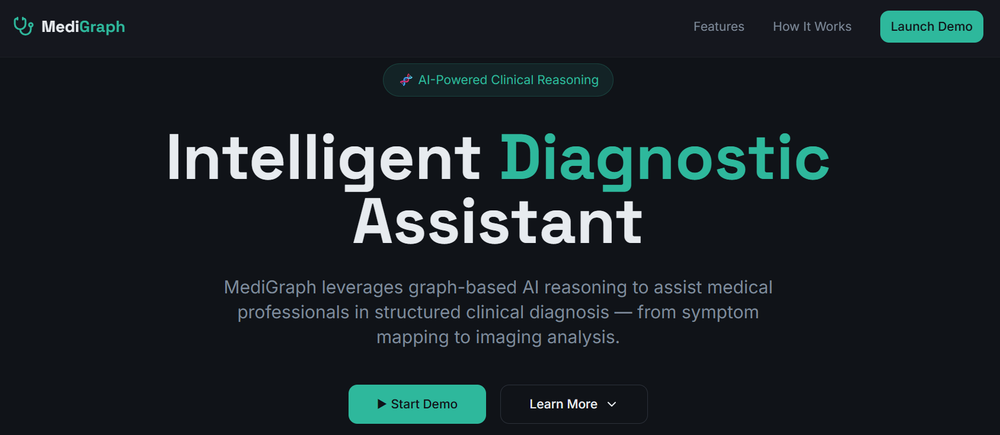
MediGraph is a multimodal AI diagnostic assistant — the first built specifically for Gulf and South Asian healthcare.
It connects three things that have never been brought together in a single clinical workflow:
MRI and imaging analysis. The scan is uploaded, displayed on screen, and the AI overlays diagnostic markers directly on the image — showing the doctor exactly where the anomaly is and what it likely represents.
Complete patient history. Vitals, symptoms with duration and severity, prior conditions, lab results — all captured in a structured 7-step clinical pipeline that mirrors how doctors actually think.
30 million live research papers. The AI cross-references every diagnosis against current PubMed literature in real time — not a static dataset, but a live knowledge base that reflects the latest global research.
The output is a ranked differential diagnosis — the top probable conditions, each with a confidence score between 60 and 90 percent, with the specific clinical evidence and research citations behind every conclusion.
Not a black box. Not just a number. A diagnosis the doctor can read, question, and act on.
The 7-Step Clinical Pipeline
Step 1 — Doctor Authentication Verified clinician login with hospital name, specialization, and medical license number. Every diagnosis is tied to a qualified professional.
Step 2 — Patient Intake Name, age, gender, chief complaint, and presenting duration. The foundation of every clinical encounter.
Step 3 — Patient Vitals Blood pressure, temperature, pulse, respiratory rate, and oxygen saturation. Critical values are auto-flagged immediately — SpO2 below 94% triggers an alert in real time.
Step 4 — Symptom Mapping Searchable symptom database with duration and severity tagging — mild, moderate, severe, critical. An AI assistant is available to help identify rare condition patterns the doctor may not have considered.
Step 5 — Clinical Imaging X-ray, CT, or MRI upload. The scan appears on screen and the AI draws diagnostic markers directly on the image with labelled findings. Multiple images supported.
Step 6 — Lab Integration PDF lab report upload or manual entry. Any value outside clinical reference ranges is flagged automatically — no scrolling through numbers looking for the anomaly.
Step 7 — AI Reasoning Engine All data is passed to the graph-based inference engine. It cross-references everything against 30 million research papers and returns a ranked diagnosis list with confidence scores, evidence citations, and recommended next steps.
Explainability — The Feature Every Doctor Actually Needs
The single biggest barrier to AI adoption in Gulf hospitals is not cost. It is trust.
MediGraph was built with explainability as a core requirement. Every diagnosis in the output shows the doctor exactly why the AI reached that conclusion — the vitals that were weighted, the imaging finding that triggered the flag, the research paper that supports the differential.
This is the difference between a tool a doctor uses once in a demo and a tool that becomes part of their daily clinical workflow.
Who MediGraph Is Built For
Hospital CMOs and Medical Directors use MediGraph to reduce rare disease referrals, improve diagnostic throughput, and position their institution at the forefront of Vision 2030's health digitization mandate.
Radiologists and Diagnostic Labs use it to handle complex cases in-house — eliminating the revenue loss that comes with every external referral, and giving patients faster, more accurate results without leaving the building.
Telemedicine platforms in Pakistan, UAE, and Saudi Arabia integrate MediGraph to add AI-powered diagnostic capability to remote consultations — bringing specialist-level reasoning to areas where specialists are scarce.
Built Here. For Here.
MediGraph is not imported from Silicon Valley and repackaged for the Gulf. It was built on regional data, designed around regional disease patterns, and developed with the specific clinical realities of Gulf and South Asian healthcare in mind.
Urdu and Arabic language support. PMDC and MOH regulatory alignment. Disease prevalence weights that reflect TB, dengue, and the genetic conditions that actually present in this region.
A 50-case diagnostic pilot has been completed. Results exceeded expectations.
What This Means for Your Hospital or Lab
Every complex case referred out represents two things — lost billing and a question mark on your institution's capability.
MediGraph keeps those cases in-house. Your team gets AI-backed diagnostic confidence. Your patients get faster answers. Your institution gets a measurable, defensible edge in a market where less than 6% of competitors have moved yet.
The window to be early is open. It will not stay open.